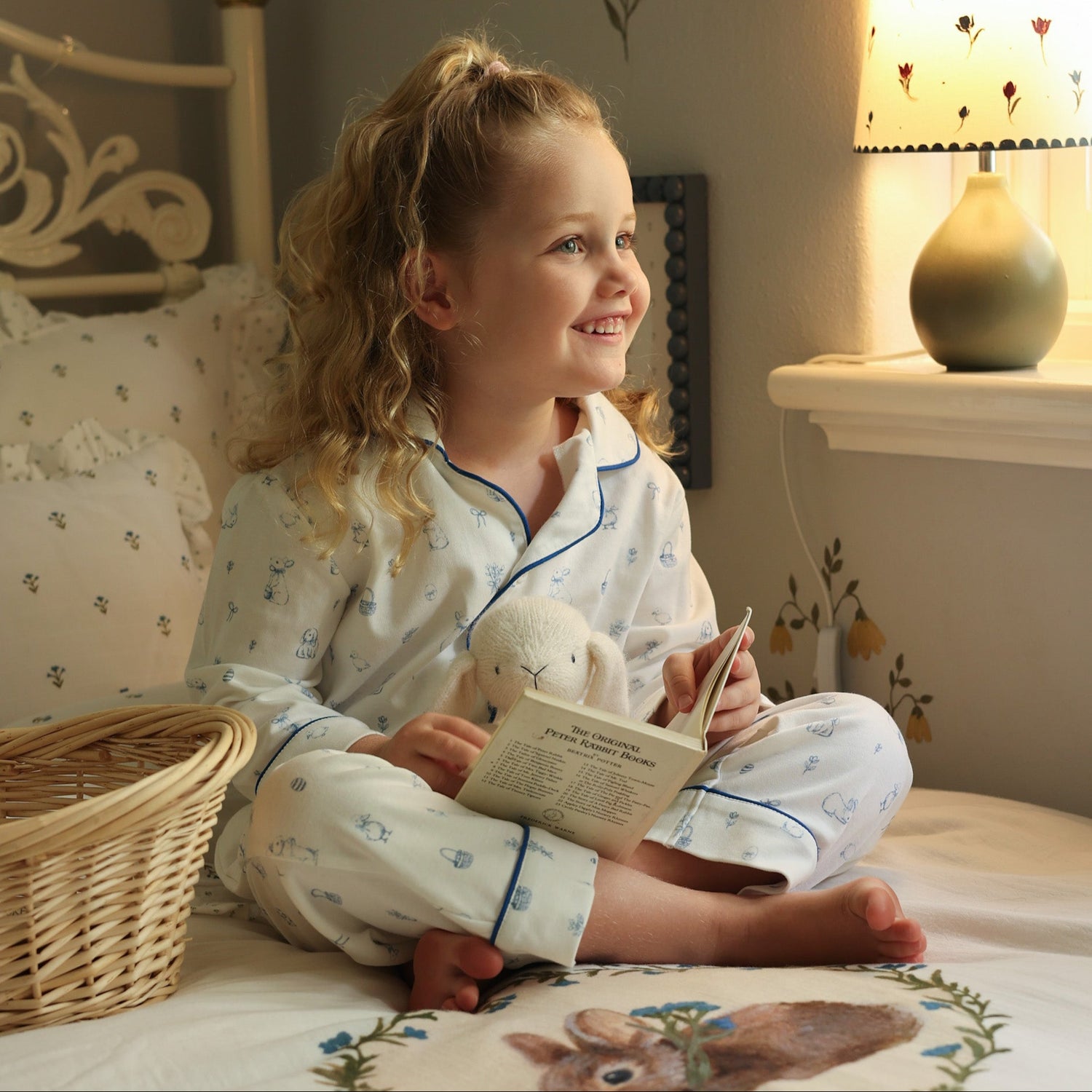

How to Layer Colour and Pattern in a Nursery
Designing a nursery is rarely about choosing one perfect thing and stopping there. The loveliest rooms are built slowly, layer by layer, with colour, pattern, texture and story all gently working together.
A nursery should feel calm enough for sleep, practical enough for everyday life, and beautiful enough to hold all the tiny memories that gather there. The trick is knowing where to begin.
For us, it always starts with one piece you love.
It might be a cot sheet, a blanket, a hand-painted print, a cushion, a special soft toy, or a piece of artwork. From there, you can build the whole room.

1. Begin with your anchor piece
Before choosing paint colours, furniture or a rug, start with one piece that already has feeling.
This is your anchor piece. It gives the room direction.
It might be a patterned cot sheet with soft greens and warm creams. It might be a blanket with a tiny character hidden inside the print. It might be an artwork you have loved for years, or a fabric that feels nostalgic and gentle.
The reason this works so well is because it gives you a clear starting point. Instead of trying to make a hundred decisions at once, you are simply asking: what does this piece already tell me?
Look at its colours. Notice the mood. Is it soft and dreamy? Playful and storybook-like? Fresh and garden-inspired? Warm and vintage? That one piece becomes your little design compass.
2. Pull out a soft colour palette
 Once you have chosen your anchor piece, look closely at the colours within it.
A beautifully layered nursery does not need a huge palette. In fact, too many colours can make a room feel busy very quickly, especially when pattern is involved.
A simple way to begin is to choose:
One main colour
One soft neutral
One deeper or warmer grounding tone
One gentle accent colour
For example, if your starting piece has soft sage, cream, warm beige and a tiny touch of dusty blue, those colours can become the foundation for the whole room.
The main colour might appear in the bedding or artwork.
The neutral might guide your walls, rug or curtains.
The grounding tone might come through timber furniture or baskets.
The accent colour might appear in a cushion, book spine, lamp shade or tiny detail in a print.
The key is not to match everything perfectly. Matching can feel flat. Instead, aim for colours that feel related, like they belong at the same little tea party.
3. Let one pattern lead
 Pattern is where a nursery begins to feel truly personal, but it also needs a gentle hand.
The most common mistake is choosing too many “hero” patterns at once. A bold wallpaper, a detailed cot sheet, a patterned rug, printed curtains and several cushions can quickly make the room feel unsettled.
Instead, choose one pattern to lead.
This might be your cot sheet, quilt, wallpaper panel or artwork. Let that piece carry the main story of the room.
Once you have your hero pattern, everything else should support it. Think of the other pieces as quiet characters in the background. A hand-painted nursery print, for example, already has movement, colour and detail. Around it, you might use plain muslin, knitted texture, timber, soft linen and smaller touches of pattern.
This gives the eye somewhere to rest.
4. Mix pattern by changing the scale
 If you do want to layer more than one pattern, the secret is scale.
Scale simply means the size of the pattern.
A large illustrated print can sit beautifully with a very small check.
A soft floral can work with a fine stripe.
A detailed storybook pattern can pair with a tiny dot, gingham or simple woven texture.
What you want to avoid is having several patterns that are all the same size and strength. When that happens, they compete with each other.
For example, you might use a hand-painted cot sheet as the main pattern, then add a plain quilted blanket, a small gingham cushion and a textured rug. The room still feels interesting, but it remains calm.
5. Use texture as a pattern too

Texture is often the quiet magic in a nursery.
When people think of layering, they often think only of colour and print. But texture adds depth without making the room feel too busy.
Muslin, linen, cotton, timber, rattan, boucle, wool, knitted blankets and soft quilted pieces all bring warmth to a room. They create little shifts in the space without needing more colour or more print.
If your nursery already has a detailed pattern, texture is your best friend.
A plain knitted blanket can soften a patterned cot sheet.
A timber cot can ground a delicate wall colour.
A woven basket can add warmth beside painted furniture.
A muslin cushion can bring softness without adding noise.
Texture is especially helpful in nurseries because it makes the room feel gentle and lived in. Less showroom, more storybook corner.
6. Repeat colours in small, thoughtful moments
 Once you have your palette, repeat it gently around the room.
This is what makes a nursery feel intentional.
If there is a soft green in your anchor piece, you might repeat it in a cushion, artwork or changing basket liner. If there is a warm cream in the print, it might appear again in the rug, curtains or lampshade. If there is a tiny blush detail, you might bring it back through a book cover or a small decorative piece.
You do not need large blocks of every colour. Sometimes the smallest repeat is enough.
The room begins to feel connected because the colours are speaking to each other across the space.
7. Keep the furniture calm
 When pattern and colour are doing the storytelling, furniture should usually feel steady and calm.
Natural timber, warm white, soft cream, muted painted finishes and vintage-inspired pieces work beautifully in nurseries because they support the layers around them.
This does not mean furniture needs to be plain or boring. Shape, detail and finish still matter. A curved cot, a beautiful chest of drawers or a timeless armchair can add so much character.
But furniture should not fight the pattern. It should ground the room.
8. Add the keepsake layer
 Once the main design elements are in place, add the pieces that make the nursery feel like yours.
This might be a soft toy sitting on a chair, a stack of storybooks, a framed print, a tiny pair of booties, a special blanket, a family heirloom or something handmade.
These are the details that give a room it's heart.
A nursery does not need to feel overly styled. In fact, the most beautiful ones often have a little softness to them. A blanket folded over the cot. A book left beside the chair. A toy waiting quietly on a shelf.
Layering does not mean adding endlessly.
A beautifully layered nursery has rhythm. Pattern, quiet space, colour, texture, story. Each piece has a role to play.
A simple nursery layering formula
Start with one piece you love.
Pull your colours from it.
Choose one hero pattern.
Add smaller-scale patterns carefully.
Use texture to soften the room.
Repeat colours in thoughtful details.
Let furniture ground the space.
Finish with keepsakes and story.
When you begin this way, the nursery grows naturally. It feels collected rather than forced. Gentle rather than busy. Personal rather than overly matched.
And most importantly, it becomes a room with feeling.
A small world, ready for all the stories still to come.
Shop this nursery Story: